

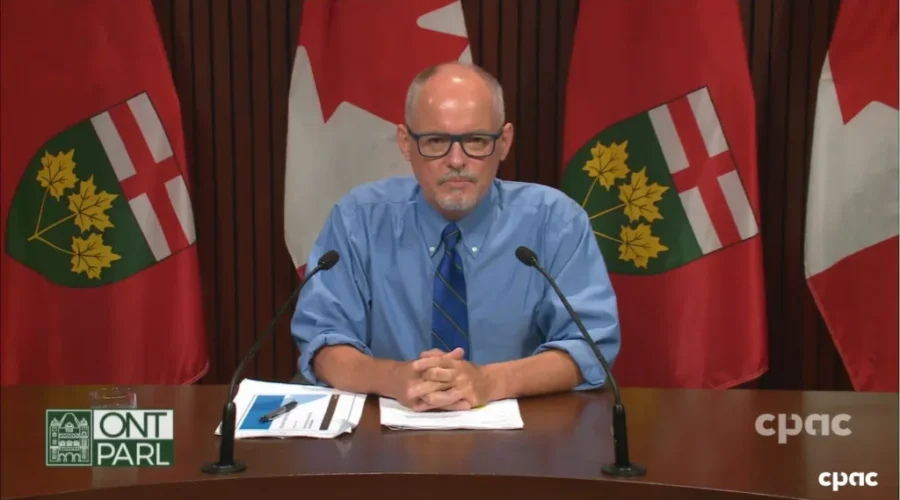
Ontario is making COVID-19 vaccine policies mandatory for “high-risk” sectors, including healthcare.
The province’s Chief Medical Officer of Health, Dr. Kieran Moore, cited the variants that have caused significant spread as one of the most important reasons for this announcement.
“It is now over 90 per cent of the detected samples are of the Delta class or variant, and we are seeing our rates of illness go up,” says Dr. Moore. “We’re also seeing our hospital rate numbers go up. As a result, we are now making these recommendations on immunization policy. I still believe there’s significant time for this to have its desired effect and that Ontarians [can] continue to embrace immunization as our ticket [to] safety.”
Hospitals and home and community care service providers are required to have mandatory vaccination policies for employees, staff, contractors, students and volunteers. Ambulance services will also be required to have a COVID-19 vaccination policy for paramedics. These policies must kick in no later than September 7.
By then, those groups will have to provide proof they are fully vaccinated, have a medical reason for not being vaccinated, or have taken a COVID-19 vaccination education session. If a person cannot prove they are fully vaccinated after that, they will be required to take regular COVID-19 antigen tests.
Looking at the upcoming school year, the Ministry of Education intends to introduce vaccination disclosure policies for publicly-funded school board employees, staff in private schools, and all staff in licensed child care settings. They will also be required to take rapid tests if they are not immunized against COVID-19.
Education Minister Stephen Lecce says he believes in these policies, and the benefits they will provide in the upcoming school year.
“With the support of Ontario’s Chief Medical Officer of Health, our government is taking action to make schools as safe as possible,” say Lecce. “Our plan will protect our schools, ensure rapid speed with contact tracing, all with the intention of keeping them open for the benefit of Ontario students.”
Vaccination policies are also being put in place in other settings like post-secondary schools, licensed retirement homes, women’s shelters, congregate group homes and day programs for adults with developmental disabilities, children’s treatment centres and other services for kids with special needs, and licensed children’s residential settings.
Along with this, Dr. Moore announced some help for the province’s most vulnerable.
Ontario will be offering third doses of COVID-19 for high risk groups, including:
- Transplant recipients (including solid organ transplant and hematopoietic stem cell transplants);
- Patients with hematological cancers (examples include lymphoma, myeloma, leukemia) on active treatment (chemotherapy, targeted therapies, immunotherapy);
- Recipients of an anti-CD20 agent (e.g. rituximab, ocrelizumab, ofatumumab); and
- Residents of high-risk congregate settings including long-term care homes, higher-risk licensed retirement homes and First Nations elder care lodges.
Vaccine eligibility is being expanded for all children born in 2009, meaning all children turning 12 before the end of 2021 will be eligible for their first dose beginning Wednesday. Currently, they will only be able to receive the Pfizer vaccine.
On top of this, rising case counts and the uncertainty surrounding the Delta variant lead to Dr. Moore pausing the provincial Roadmap to Reopen.
He did not provide a timeline for when more restrictions would be eased in Ontario.

